Newtongrange Welfare Park Centenary – wishing to celebrate the best of mining welfare
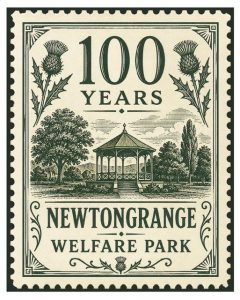
On the afternoon of Saturday 19th of September 2026 there will be an apt celebration for the pride an joy of the former mining village Newtongrange Welfare Park.
The park is briefly covered when walking the Local mining landscape – Newtongrange route. While walking the route you will notice that Newtongrange has been described as a model mining village and we hope that the essential new housing and Line Dyke repairs are sympathetic to this vision.
Newtongrange Community Council is currently pursuing along with the National Mining Museum Scotland a Newtongrange Heritage Trail, that will hopefully benefit visitors and residents alike and strengths the connection between museum and village. The ultimate aim is for the park to get suitable plaques to record the ‘living history’ of the green lungs of the village. The park a Field in Trust and the local community has recently scrubbed and repainted the park fencing with support from local businesses and charities. The tennis courts have been refurbished and available to book, Newtongrange Petanque Club, whose terrain is in the park are riding a crest of a wave both nationally and internationally and The Pavilion Cafe funded by the Newtongrange Development Trust is open and well worth a visit.
The park was officially opened on Saturday 11th of September 1926 and the event attended by Lord Chelmsford is vividly captured by a British Pathé Archive titled “Lord Chelmsford opens first children’s playground to be erected under Miners’ Welfare Fund in Colliery Districts“.
The park was originally supposed to be for the children but it was only five acres and also contained a cricket pitch. There were complaints that the park was “monopolised” by the cricketers and conversely that the children damaged the pitch. Newtongrange Star, the local football team had their own pitch, Victoria Park, next to the public park. (Anderson 1986)
This the first incarnation of Newtongrange Victoria Park existed from 1890-1924. The pitch was situated on a piece of ground that is now the swing park and the pavilion built in 1903 along the wall at St Davids. (Hickie 2010)
Considering the local newspaper account of the opening it is clear that the vision for the park was to accomodate and celebrate the child:
Viscount Chelmsford, who was accompanied by Commander Coote, R.N., formally opened the park, claimed to be the first of its kind in Scotland. It extends to about 17 acres, and has a cricket pitch with pavilion; a putting green with separate pavilion, and There is a bandstand in the centre of the park, whilst there are flower-beds and shrubs, and a rockery with numerous herbaceous plants are among the other features. The park has cost about £9,000.
The company included Mr James A. Hood, J. P., Midfield, the Chairman of the Lothian Coal Company., and Mrs Hood ; Mrs Mackay, Mr J. C. Murray, Secretary of the Company, and Mrs Murray; Sir Henry Dundee, Bart.; Mr Joseph Westwood, M.P., Mr Andrew B. Clarke Provost and Mrs Doughty, Dr and Mrs McKenzie, Mr J. Rutherford, J.P. Chairman Newbattle Parish Council, Mr A. Dougall, Mr P. Milligan, and Dr R. Inch, Gorebridge; and Mr Wm. Kirkwood, Secretary of the local Welfare Committee
Mr Mungo Mackay said he should like to say first of all, on behalf of the members of the local Welfare Committee and himself, how pleased they were to see them there that day, and to thank them for their presence at the opening of the Newtongrange Welfare Park and Children’s Play Centre, an event which was an important one in the life and welfare of the village. ceremony. Newtongrange had more advantages for health and recreation of its inhabitants than many towns of larger size.
The park is entirely for the pleasure of the villagers, it should be the duty of each individual to take an interest in its beauty, and prevent anything being done to mar it. The play centre would certainly be taken advantage of by the children, and would be a happy corner for many of them. He believed that was the first play centre of its kind to be erected in Scotland, and were much indebted to Commander Coote, Royal Navy, for his advice and assistance in the selection and layout of the equipment.
Without doubt, the public park would be an additional attraction to the village, and would be much appreciated by its inhabitants.
Coote was invited lto go to America to sit in conference with those interested in welfare work and see what they were doing, especially with regard to children.
They were very far behind America in the matter. The United States had gone far ahead with children’s welfare work, and they looked to get results in the education of their children from their early training in recreation.
That day the Welfare Park had just been opened, and as Lord Chelmsford had explained, it was especially devoted to the children. That was a new departure. In the past they had catered more for adult recreation and amusement, but now the children were being provided for. All children under a certain age were to be allowed into the play centre, and he hoped that, all the parents would encourage them go there, and that it would turn out to be a success.
It had undoubtedly set a very high standard of housing, and now they were in the fortunate position of being the first to open a public park and children’s play centre through the medium of the Welfare Fund.
Lord Chelmsford then proceeded to the play centre, where he was presented by Miss Ina Pearson with a gold key, with which he opened the gate. The children were then admitted, and the various amusements set in motion, Lord Chelmsford himself taking part in . the exhilarating enjoyment on one of the swings. Another interesting part of the day’s proceedings was the opening of the putting green by Mrs Mackay, who was presented with a putting club by Mr Rutherford as a memento of the occasion. (The Dalkeith Advertiser 16 September 1926)
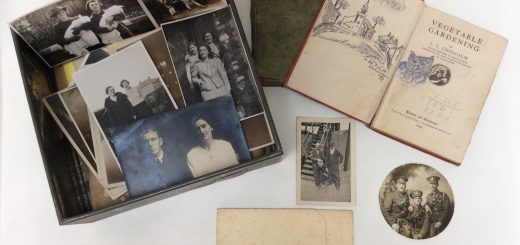
Along with the centenary event there will be a local history exhibition with images and stories of the park in Newtongrange Library in September. This is coordinated by the reminiscences group the Village Voices who also contributed to the excellent Before and After Coal exhibition @ the National Portrait Gallery in 2024. The groups recollections of childhood park memories including the parkie’s whistle, breaking a wrist on the penje and the numerous sunny gala days – another way to celebrate the best of mining welfare.
References:
The Dean Tavern A Gothenburg Experiment / Anderson 1986
The history of Newtongrange Star FC 1890-2010 / Hickie 2010
The Dalkeith Advertiser 16 September 1926